Canton Data Center
Size of Project
1,713 Acres
Duct Bank Installed
13.47 MI
Underground Conduit Installed
40.43 MI
Duct Bank Vualts Installed
248
Location
Canton, MS
Industry
Mission Critical / Data Centers
Status
Completed
Overview
Building the Systems Behind Mission Critical Operations
Data centers depend on an extensive network of infrastructure hidden beneath the surface. Long before servers come online, the systems carrying power, cooling water, fire protection, and communications must be installed throughout the campus.
At the Canton Data Center, RNGD built the underground network that supports power, cooling, fire protection, and connectivity across the campus. The team delivered major wet and dry utilities within a fast-moving mission critical environment, setting the stage for a prefabrication strategy built around speed, control, and installation certainty.
The size of the scope was one challenge. The speed required to complete it was another. Mission critical construction moves quickly, and the infrastructure beneath the campus had to stay ahead of the buildings, equipment, and additional crews following behind it.
RNGD was ready for that challnege.
Delivering Utilities at Campus Scale
The wet utilities at Canton operated at a scale well beyond a conventional commercial installation. Some chilled water lines reached 20 inches in diameter, with portions installed in excavations approximately 15 to 18 feet deep.
These systems would ultimately support cooling and fire protection across the campus. Their size and depth required extensive excavation, careful sequencing, and close coordination with the electrical and communications infrastructure sharing the site.
RNGD entered the work early, giving the team an opportunity to install major utilities before the site became increasingly congested. That head start helped minimize conflicts as additional contractors, equipment, and construction activities moved into the same areas.
But as timelines continued to accelerate, the team recognized that conventional field installation alone would not provide enough production certainty for one of the campus’s most critical systems.
The Duct Bank Bottleneck
Electrical duct banks form the pathways that carry power and fiber throughout a data center campus. Until those pathways are installed, connected, and ready, the systems depending on them cannot advance.
Conventionally, duct bank construction places most of the work inside the excavation. Crews dig the trench, assemble the conduit in place, prepare the system for concrete, complete the pour, allow the section to cure, and return to backfill before moving forward.
That sequence leaves production exposed to field conditions. Rain can interrupt concrete placement and fill open excavations, requiring pumping and repairs before work continues. Materials and crews must operate inside an already active construction zone. Each section depends on the one before it, creating a process where one disruption can slow everything behind it.
At Canton, the scale and pace of the duct bank scope demanded a more efficient approach. The team needed a way to increase production without simply adding more people and more activity inside the trench.


Turning Prefabrication Into Production
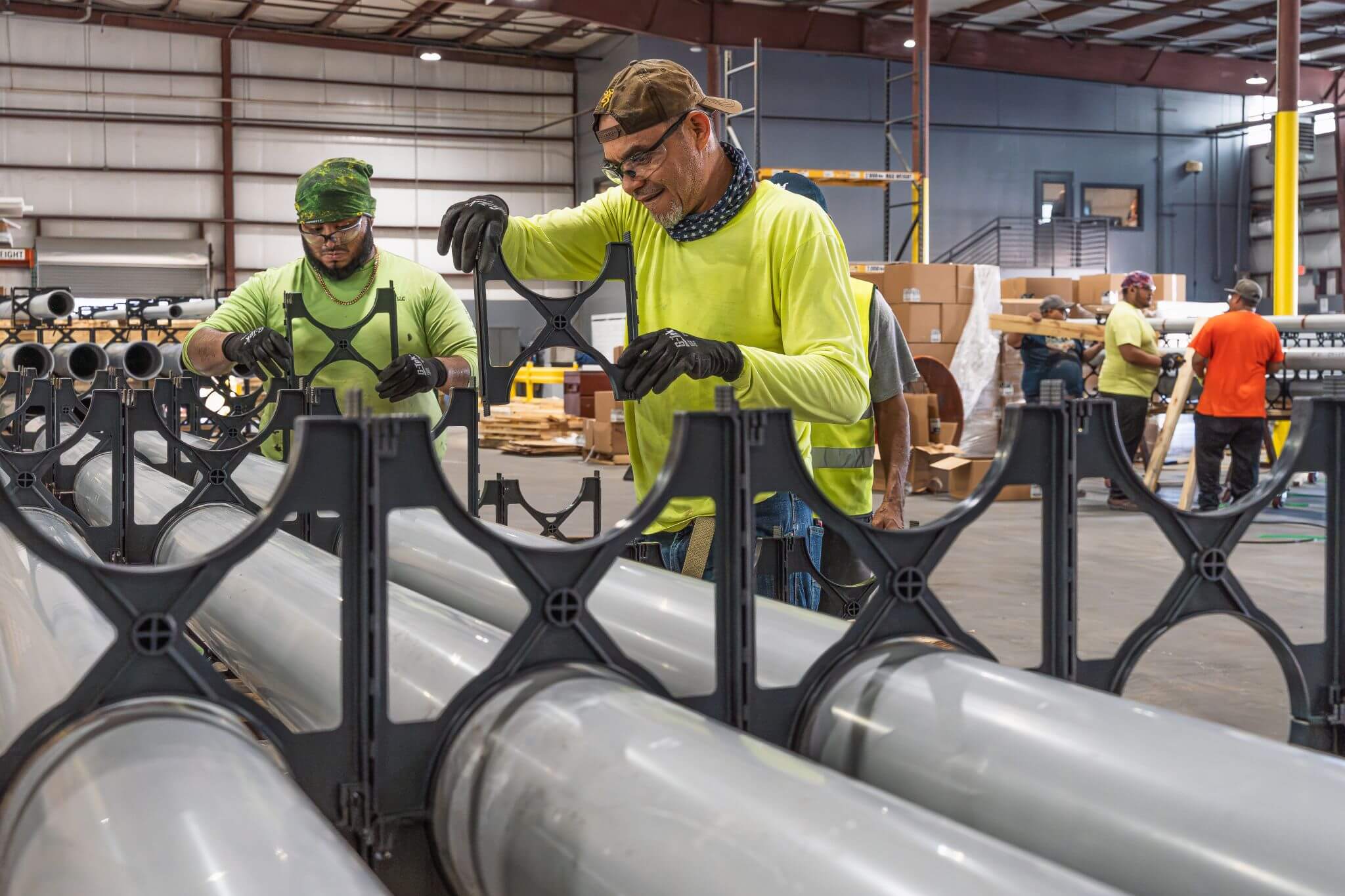
The team developed a project-specific prefabrication strategy that shifted duct bank production into a dedicated operation near the Canton project. After coordinating the approach with the project’s engineering and client teams, RNGD brought production closer to installation, reducing transportation and double handling while keeping components readily available for field crews.
Instead of constructing every duct bank section entirely inside an open excavation, repeatable components could be produced ahead of field demand in a more controlled environment. While installation crews prepared the next corridor, the prefabrication team continued building the sections that would follow.
That changed the sequence. Production no longer had to begin and end in the trench. Prefabrication and site preparation could advance at the same time, creating a steady flow of installation-ready sections to the field.
The strategy also gave the team flexibility. RNGD used cast-in-place construction, prefabricated conduit assemblies, and precast components based on the conditions and needs of each area. Prefabrication was incorporated into the project where it could improve production and accelerate field installation.
This approach reflected the Renegade Delivery Method by connecting coordination, manufacturing, logistics, and field installation through one delivery strategy. In-house BIM and clash detection helped identify potential conflicts before work reached the field, while 3D machine control supported precise grades during installation.
Built for Speed. Installed With Certainty.
Prefabrication gave the Canton team a faster and more controlled path through miles of underground electrical infrastructure.
Producing components in advance reduced the work required inside active excavations. It also limited weather exposure, reduced material handling in the primary work area, and shortened the time crews needed to spend building each system from the ground up in the trench.
Controlled production also improved repeatability. Each assembly followed a coordinated process before reaching the installation area, creating greater consistency while reducing the field variability that can lead to rework and conflicts.
For the larger project team, the advantage was certainty. Manufacturing and installation were aligned under one team. Components were produced around field demand. Installation methods could adapt to changing conditions without losing sight of the project’s mission critical timeline.
At Canton, the team delivered wet and dry utilities the campus required while proving a faster way to build one of its most schedule-sensitive systems. By moving repeatable work out of the trench and into a project-adjacent prefabrication operation, the team helped essential power infrastructure advance with greater speed, quality, and control.